

Moodan
GTM
9 Apr
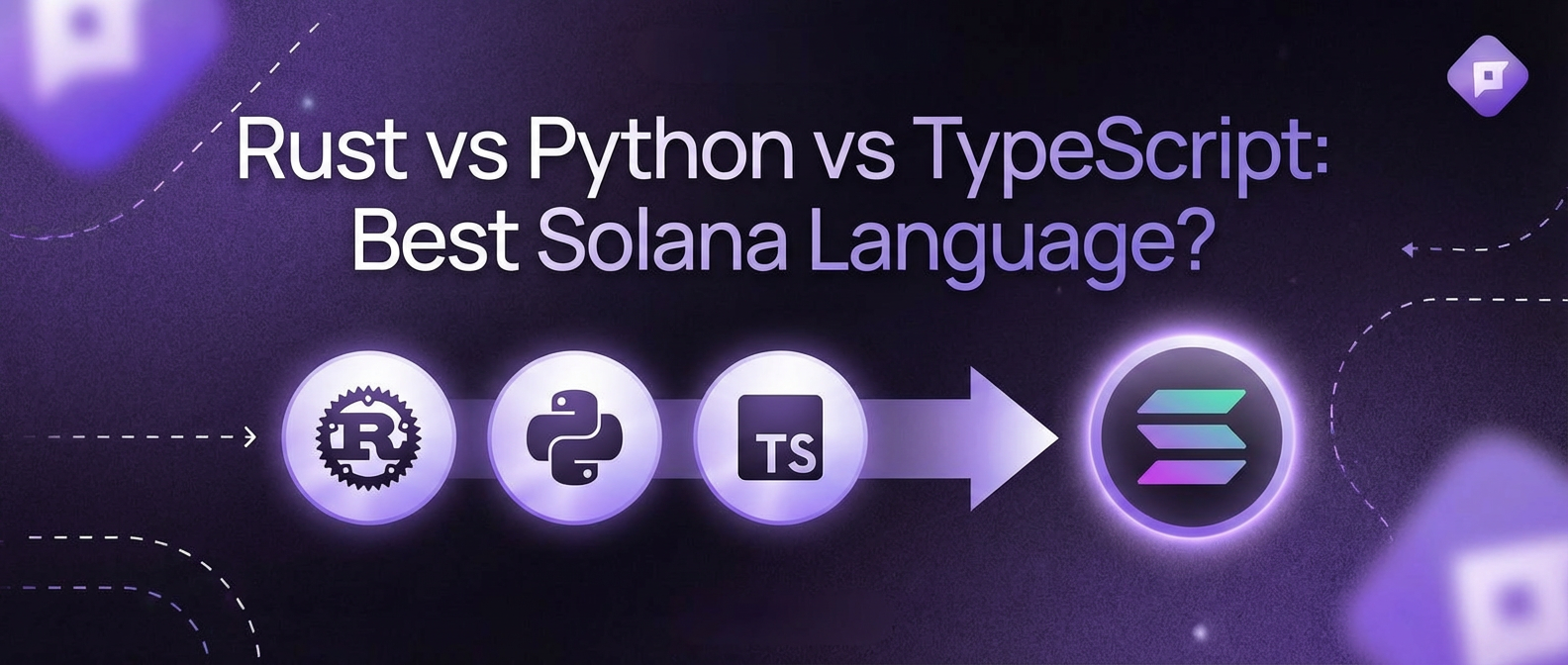
Rust vs Python vs TypeScript: Best Solana Language?
The Developer's Dilemma: Choosing the Right Stack
When developers enter the Solana ecosystem, the first major architectural decision is selecting a programming language. Historically, this choice dictated your entire operational ceiling. Rust offered unparalleled native speed but demanded a steep learning curve. TypeScript provided the easiest onboarding via @solana/web3.js but suffered from single-threaded bottlenecks. Python remained the absolute favorite for quantitative analysts, yet its asynchronous web3 libraries often lagged during critical network congestion.
In 2026, the landscape of decentralized finance (DeFi) has evolved. If you are building high-frequency trading algorithms, sniper bots, or automated market-making tools, you no longer need to write hundreds of lines of boilerplate code to handle blockchain serialization. By transitioning to a programmatic execution engine, the playing field is completely leveled.
Whether you build a Solana trading bot in under 50 lines of code using Python or orchestrate a fleet using TypeScript, the underlying execution speed is identical. This guide compares the traditional SDK experience against modern REST architecture and proves why your hosting location matters far more than your syntax.
The Traditional Bottlenecks of Native SDKs
Before API-first infrastructure became the standard, developers were forced to interface directly with Remote Procedure Call (RPC) nodes using language-specific libraries. This introduced severe friction depending on your chosen stack:
- Rust: While inherently the fastest, managing asynchronous RPC clients and constructing complex Jito bundles in Rust requires deep systems-level knowledge. Memory management and strict compiler rules slow down rapid prototyping in volatile memecoin markets.
- TypeScript: The most widely adopted language in Web3, but Node.js's event loop can choke under heavy multi-wallet signing loads. Handling 50 concurrent keypairs locally often results in dropped transactions.
- Python: The undisputed king of data science and AI trading logic. However, handling real-time blockchain streams and raw byte serialization in Python introduces micro-delays that lead to devastating price slippage.
By relying on standard libraries, developers spend 80% of their time managing dropped packets and blockhash expirations rather than refining their alpha-generating strategies.
The REST API Paradigm Shift
To compete at an institutional level, professional operators decouple their trading logic from the blockchain execution layer. By routing requests through an optimized REST API, the heavy lifting—transaction building, cryptographic signing, priority fee calculation, and parallel broadcasting—is offloaded to a dedicated, globally distributed Rust backend.
Code Comparison: Executing a High-Speed Snipe
To understand how language neutrality works in practice, let's look at executing an instant multi-wallet buy. If you were using native libraries, coordinating an atomic execution across 10 wallets would require drastically different logic in Rust compared to Python.
By targeting the Instant Trading documentation, you can trigger parallel swaps across your entire fleet using the exact same JSON structure, regardless of your stack. The backend receives your HTTP request and injects your trades directly into premium validator lanes.
You will notice the ULTRA priority fee designation in the code above. If you want to learn how algorithmic systems dynamically adjust network tips during severe congestion, explore the Priority Fee settings natively integrated into the platform.
Proximity Over Syntax: The Latency Truth
If the execution engine abstracts the blockchain interaction, what actually differentiates a profitable trading system from a slow one? In modern DeFi, your bottleneck is no longer parsing JSON or structuring code—it is the physical speed of light. The geographic location of your server matters exponentially more than whether you wrote your script in Go or Python.
To achieve maximum profitability, you must optimize the following environmental factors:
- Virtual Private Server (VPS) Location: Launchpad operates globally distributed nodes across the US, Europe, and Asia. If you host your Python script in an Amsterdam AWS region, your HTTP handshake with the European API node will take 1-2 milliseconds. A highly optimized Rust script hosted in a residential basement in Ohio will lose to that Python script every single time.
- Connection Keep-Alive: By maintaining a persistent SSL/TLS connection between your server and the API, you bypass the cryptographic handshake overhead for subsequent trades.
- Infrastructure Priming: Setting up Durable Nonce Accounts in advance strips away the synchronous blockhash latency layer entirely. You must implement the Initialize Wallets instructions to ensure absolute 0-latency block inclusion.
To dive deeper into setting up optimal hardware environments, review the comprehensive Best Practices guide. Furthermore, you can discover exactly how standard infrastructure slows you down by reading our detailed breakdown of Solana RPC alternatives.
Code Comparison: Fleet Management at Scale
If you are a developer looking to deploy sophisticated project operations, executing single swaps is merely the beginning. True market mastery requires generating, funding, and commanding entire fleets of cryptographic keypairs.
Building bulk generation loops in native programming languages requires robust local state management and introduces severe security risks if seed phrases touch local disks. By leveraging the programmatic endpoints, developers can rapidly invoke up to 100 decentralized wallets within a single request.
Explore the parameters in the Create Wallets documentation. Combined with intelligent routing, this forms the foundation of any professional launch stack. If you intend to automate token deployment as well, it is highly recommended to read our tutorial on how to create a Solana token in seconds.
After generating your fleet, you can utilize atomic transaction logic to bypass mempool vulnerabilities entirely during initial liquidity offerings. Check our guide on how to build a Solana sniper bot and examine the Create Token parameters to master block-zero deployments.
The Final Verdict on Language Choice
The debate over Rust, Python, or TypeScript is ultimately a distraction when building on modernized API infrastructure. The best language for building on Solana is simply the one your development team is most proficient in.
By abstracting away Remote Procedure Call complexity, cryptographic signing, and transaction propagation logic, developers are freed to focus entirely on algorithm design. As long as you host your operational scripts in geographical proximity to the executing nodes, you will achieve the absolute apex of performance.
Frequently Asked Questions
- Does coding in Rust guarantee faster execution than Python on Solana?
Not when utilizing a REST API execution engine. Because the API backend handles the raw blockchain serialization, the language you use to construct the HTTP payload has virtually no impact on final execution speed. - Why is server location so critical for API-driven trading bots?
Network handshake latency is constrained by the physical speed of light. Hosting your server in a data center directly adjacent to the API's global routing nodes (such as Amsterdam or Tokyo) shaves dozens of milliseconds off your total response time. - Can I manage multiple cryptographic wallets safely without using native SDKs?
Yes. The API operates on a strict non-custodial architecture where your private keys are processed ephemerally in server memory solely for the fraction of a second needed to sign the transaction, preventing local disk exposure. - Do I need advanced programming knowledge to deploy a Pump.fun token?
No. With API abstraction, deploying a token requires only a basic JSON post request. There is no need to write, compile, or audit complex Rust smart contracts.
Upgrade your infrastructure and start building with Launchpad today
Discover also
8 Apr
Pump.fun Bundler Guide: Safely Launch with 15 Wallets
Learn how to use a Pump.fun bundler to launch tokens and distribute supply across up to 14 wallets at Block 0 using Jito bundles to prevent early snipers.
Moodan
GTM

7 Apr
Privacy Protocols and Wallet Isolation on Solana
Learn how to protect your Solana trading strategies with transaction isolation, compartmentalized transfers, and professional fund routing to prevent clustering.
Moodan
GTM
.jpg)
6 Apr
Manual Trading vs. API Trading on Solana: Finding Your True Edge.
Discover how a Solana trading API beats manual clicking. Compare 25ms execution speeds, multi-wallet automation, and Jito bundles in volatile markets.
Moodan
GTM